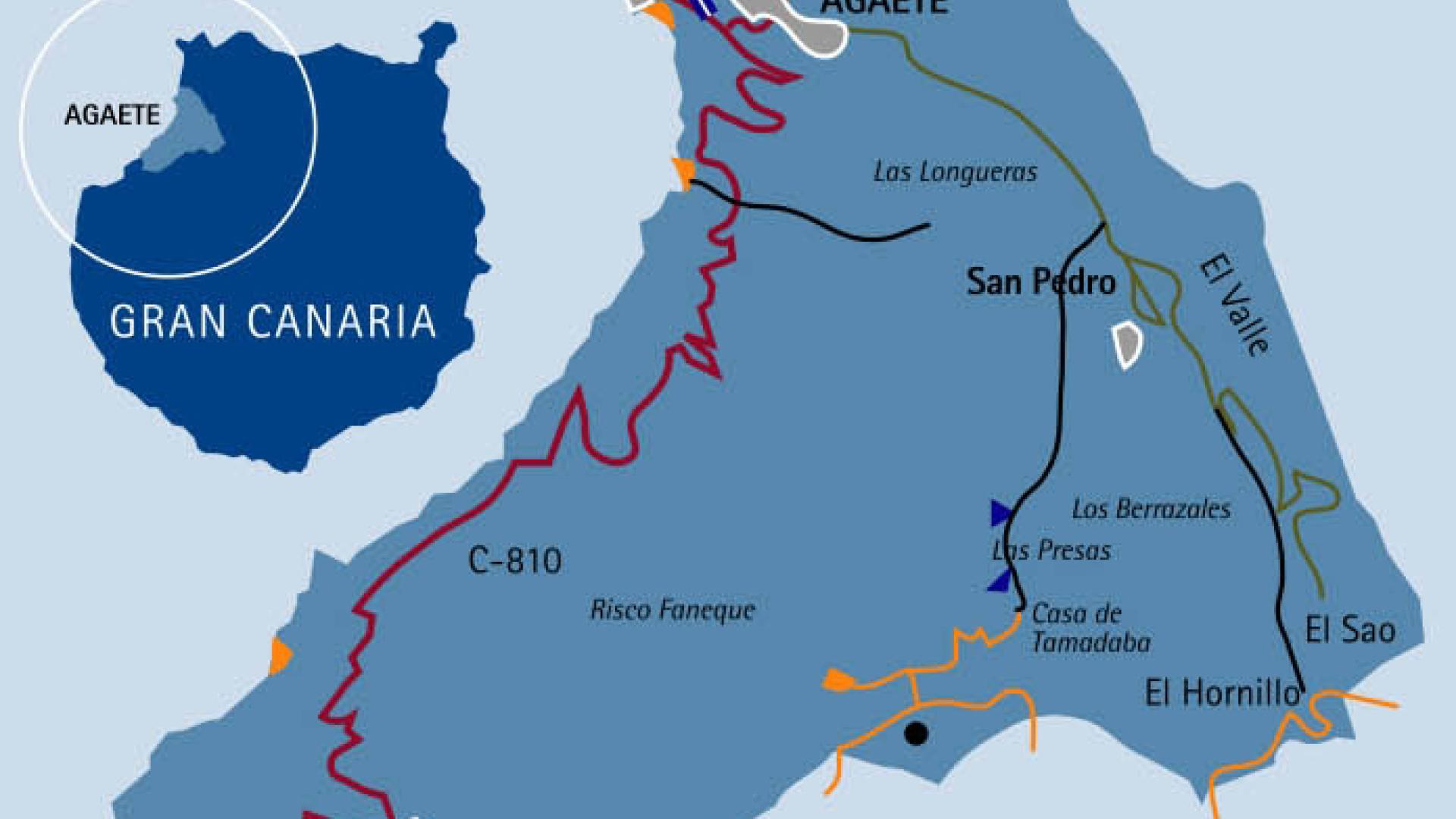

Geography
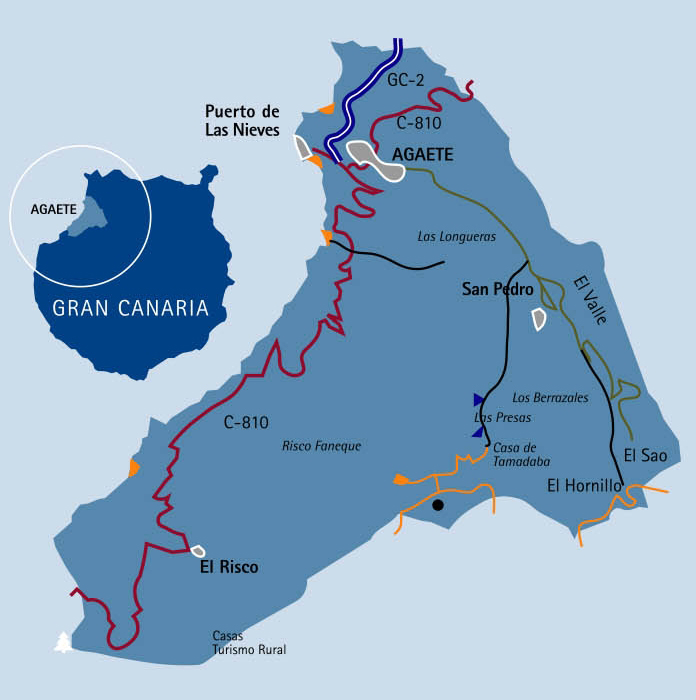
Geography
Size and orography
Despite its small area, 45.49 square kilometres, its topography is generally very abrupt, and three main basins stand out: El Risco, Guayedra and Agaete, reaching a maximum altitude of 1,180 metres in the summit area of Pinar de Tamadaba.
Climatology and vegetation
With a predominantly north-westerly orientation, the municipality of Agaete, with the exception of the high area in Tamadaba, does not offer frontal exposure to the trade winds, which causes a shortage of rainfall, which is aggravated by the large runoff caused by the slopes and by not having adequate reservoirs for the damming of surface water. Due to this north-westerly orientation, there is a shortage of rainfall in this town throughout the year, marked by a large number of hours of sunshine, with an annual average of about 2,415 hours, these characteristics being the main causes of the warm climate in the area.
Rainfall is irregular and scarce, with maximum rainfall reaching just under 700 l/m2 in Tamadaba, 265 l/m2 in Guayedra and less than 200 l/m2 in Agaete and el Risco. This aridity determines, in the areas below 400 metres, the predominance of a very scattered cover of scrub, tabaibales and remains of cardonales (Euphorbia canariensis). In the valley bottoms there are some palm groves (Phoenix canariensis), as in Guayedra, El Risco or El Valle, and only in the peaks of Tamadaba does the forest of Canary Island pines (Pinus canariensis) appear.
Although all the plant landscapes have been subjected to grazing and felling in previous centuries, this pine forest is the pine forest with the greatest variety of flora in Gran Canaria. The height and the condensation caused by the trade winds, in their rapid ascent along the terraces that fall to the sea, allow us to speak of a humid pine forest, in which pines coexist with the undergrowth of rock roses (Cystus simphytpholius and Cystus monspeliensis), heather (Erica arborea) and beech (Myrica faya). Finally, the upper limits of the escarpments, especially the notches carved in them by the headwaters of Guayedra, are home to vegetation with interesting endemic species and species of the laurel forest.
In the area of the Risco there are two unique endemic species: Dendriodotserum Merendozii and Centaurea Arbutifolia.


